 Mission Zero
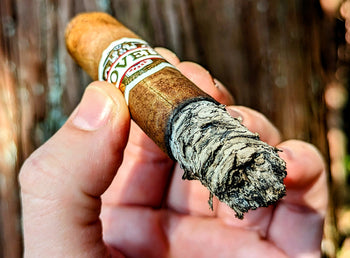
Smoking a square cigar may sound strange to some people, but there is nothing out of the ordinary when it comes to blocky premium cigar blends. Although the reasoning behind the formation of square cigars remains shrouded in mystery, they continue to sell extremely well, thus encouraging cigar companies to produce both box-pressed and trunk-pressed cigars by the millions every year.
But I'm getting ahead of myself. Perhaps we should first make sure that you know the difference between a box-pressed and a trunk-pressed cigar. It's alright if you don't. A lot of people are unsure as to what the difference between the two is, hence us having this little chat today.
While a box-pressed cigar, or a "soft box-pressed cigar" as it is more commonly called, features a blocky shape, its corners are rounder in appearance. In contrast, a trunk-pressed cigar features crisply lined edges that are nearly 90° in orientation. Both cigar types undergo the same assembly methods, with a bunch of long-filler leaves inside, a binder atop them, and then a roll and a cigar cap finishing things off. But it is during their assembly, and the processes that follow that final roll, that things go from round to square...
How Square Cigars Take Shape

Regarding the reason why cigars started getting pressed into square or rectangular shapes all those decades back, that is a topic that remains shrouded in mystery and riddled with opinion.
While Cuba appears to be the first to produce box-pressed and trunk-pressed cigars, new world cigar manufacturers have adopted these production methods for multiple reasons. Some say that it aids in the construction and build of the cigar's ash. Others say that it encourages airflow and combustion. Pressed cigars also are not nearly as inclined to roll off a table or an ashtray, and from a boxing standpoint, they do fit snugly next to one another.
A Few of Our Favorite Box-Pressed & Trunk-Pressed Cigars
Esteban Carreras "Chupacabra Hellcat"
EP Carrillo "Encore"
Dapper Cigar Co. "El Borracho Natural"
Curivari "Buenaventura BV560 Maduro"
AJ Fernandez "New World Dorado"
Plasencia "Alma del Fuego"
Cavalier Genève "BII Viso Jalapa"
La Aurora "Family Creed Fuerte Sol"
By purposefully under-filling the cigar and then moistening the wrapper so that it does not crack under pressure, these square-shaped styles of cigar undergo a self-explanatory pressing process to achieve their unique shape. Requiring the use of either mechanized presses or old-fashioned manpower, the act of creating a blocky cigar can take anywhere from a few hours to a few days to reach the intended shape.
By combining pressure, time, some block-shaped confines, and/or a group of stogies stuffed together inside of their final dressing box, cigar makers are able to shape what would normally be rotund into an almost rectangular profile. To shine a little more light on this most "pressing" subject, let's review how these two different processes are implemented, and the key physical differences between a box-pressed cigar and a trunk-pressed smoke.

Soft Box-Pressed Cigars

Cigars that are somewhat square in shape, or do not have a razor-sharp 90° angle running down each side, are what are commonly known as "soft-pressed cigars." These cigars receive just enough of a pressing that they sit somewhere between a round "parejo" and a firm trunk-press. Granted, some soft-pressed cigars are more blocky looking than others, so there is some margin of overlap that can lead to misidentification. Hence, over the years, it becoming increasingly common in mainstream cigar culture to refer to these types of smokes as box-pressed, and not soft-pressed, even though both titles are applicable.
To create the average box-pressed smoke, a full production run of stogies is made, and then placed in its appropriate cigar box packaging. All smooshed together, without any form of divider in between each stick, these cigars are gradually pressed prior to the final packaging stage, where things like cigar bands and cellophane are applied. While it is possible to soft-press cigars with their bands and cellophane already applied, certain cigar manufacturers apply these finishing touches post-pressing to reduce the risk of damage to the cigars themselves and the finishing touches that adorn them.
Trunk-Pressed Cigars

In contrast, a "trunk-pressed cigar" receives a far more rigorous pressing procedure to achieve its sharp edges. To do so, each cigar is individually compartmentalized inside molds that feature dividers to prevent each stick from pushing up against its neighbors.
Once the tray is filled, the cigars are then pressed, which, like box-pressed cigars, requires evenly distributed amounts of pressure to be applied via a vice. Despite its imposing iron structure, this is a very delicate process, for the proper amount of pressure must be applied to form those crisply lined sides, while not cracking the wrapper. Apply too little pressure, and you will not be rewarded with that razor-sharp edge, so like any good premium cigar tobacco blend, finding the right balance is key.
Furthermore, unlike the far more common, and rounder, box-pressed cigar, trunk-pressed stogies are often exposed to longer pressing times and routine rotation. By applying even amounts of pressure on more than one side of the cigar, and allowing gravity to do some of the heavy lifting, a more pronounced edge is produced.
Finally, it is worth noting that trunk-pressed cigars typically receive their bands prior to being pressed. This not only guarantees a tight crease on the band itself, but it also makes application a hell of a lot easier, since getting a band to sit tightly across a series of 90° bends is neither easy nor time efficient.
Parting Puffs

Being that most people immediately associate a square-shaped cigar with the words "box" and "pressed," it has become fairly commonplace to hear of a trunk-pressed cigar being referred to as a box-pressed blend. While this is technically incorrect, there are plenty of instances where the lines blur. Structurally, certain cigars sit somewhere between the two, and without a razor-sharp edge and VIP access to the pressing room, it is difficult for the smoker to determine if it is one kind of pressing or another.
Here at Klaro, we tend to categorize any cigar that has some form of pressing applied to it as a box-pressed cigar, with trunk-pressed cigars falling under a sub-category beneath this blanket term. Due to us being an online operation, this helps buyers easily identify the style of cigar they are selecting. Furthermore, we have noticed that this blanket term has become more widely accepted across the cigar industry as a whole. Even if the processes and end results are quite different in various ways, ease of identification matters a whole hell of a lot, hence us rolling with the "box-pressed" classification for all square-shaped cigars.
Personally, we love both box-pressed and trunk-pressed cigars equally, and will continue to stock, smoke, and sell them as long as they remain available to us. In fact, we adore blocky cigars so much, that we recently released our own Box-Pressed Cigar Bundle. just so that you, our Klaro Crew, can smoke around a bit and try out some different square sticks. So if you've never had a box-pressed or trunk-pressed cigar, or haven't smoked one in a hot minute, snag up a boxy blend or two and see how they perform next to their rounded, parejo cousins. What you discover may surprise you...